Winter Haiku: Japanese Season Words (Kigo) and How to Write One
Want to write a winter haiku, but not sure which words count as winter, or how to make the lines fit 5-7-5? This guide lists Japanese winter season words (kigo) with their English meanings, explains how to write a winter haiku step by step, and shows a free tool that gives you 5-7-5 ideas from a name or a favorite word.
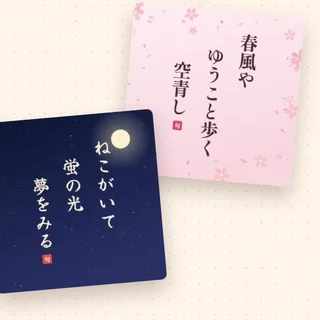 Haiku MakerType a name or word and get a 5-7-5 haiku with a season word. Free, no sign-up.Open the tool
The short answer: one season word, one real moment, 5-7-5
- A traditional haiku includes one season word (kigo) that tells the reader when the poem takes place.
- In the Japanese haiku calendar, winter runs from the start of winter (Rittō, November 7 in 2026) until the day before the start of spring in early February.
- Use only one season word. Two (say, "snow" and "tangerines") makes it unclear which one is the focus.
- Write about something you actually saw or did. Show the scene instead of explaining your feelings.
Winter season words (kigo) list
Weather and sky
snow (yuki), first snow (hatsuyuki), cold winter wind (kogarashi), north wind (kitakaze), frost (shimo), winter drizzle (shigure), clear winter day (fuyubare)
Home and food
kotatsu (heated table), gloves, roasted sweet potatoes, hot pot (yosenabe), snowman, mandarin oranges (mikan), daikon radish, napa cabbage
Days and events
start of winter (Rittō), Shichi-Go-San (children's festival in November), winter solstice, yuzu bath, Christmas, New Year's Eve, Indian summer (koharubiyori)
Animals and plants
swans, wild ducks, fallen leaves, withered leaves, sasanqua camellia, narcissus
Things you feel
white breath (iki shiroshi), cold (samushi), winter morning, winter night
Note that koharubiyori literally contains the word "spring," but it is a winter season word: a warm, sunny day in early winter. Also, in Japanese haiku, New Year words (like New Year's Day or the first calligraphy of the year) belong to a separate "New Year" season, not winter.
How to write a winter haiku in 5 steps
1. Pick one season word
Choose something from the list you have really seen or touched lately, like your breath turning white on the way to school.
2. Jot down the moment
When, where, who, what happened, how it felt. Single words are enough: "morning, bus stop, white breath, laughing with a friend."
3. Fit it into 5-7-5
In English, count syllables: "win·ter·mor·ning·light" is five. Arrange your notes into lines of 5, 7 and 5 syllables.
4. Check for a second season word
If your snow haiku also mentions mandarin oranges, swap one of them for a different word.
5. Read it aloud and trim
Cut words that explain too much. "My hands turn red" lets the reader feel the cold without you saying "it was so cold."
A famous winter haiku by Masaoka Shiki (1867–1902) describes asking again and again how deep the snow is. He was ill in bed and could not go outside, yet the poem never says he was lonely. The feeling comes through anyway.
Get 5-7-5 ideas with the Haiku Maker
1. Enter a word and choose "Winter"
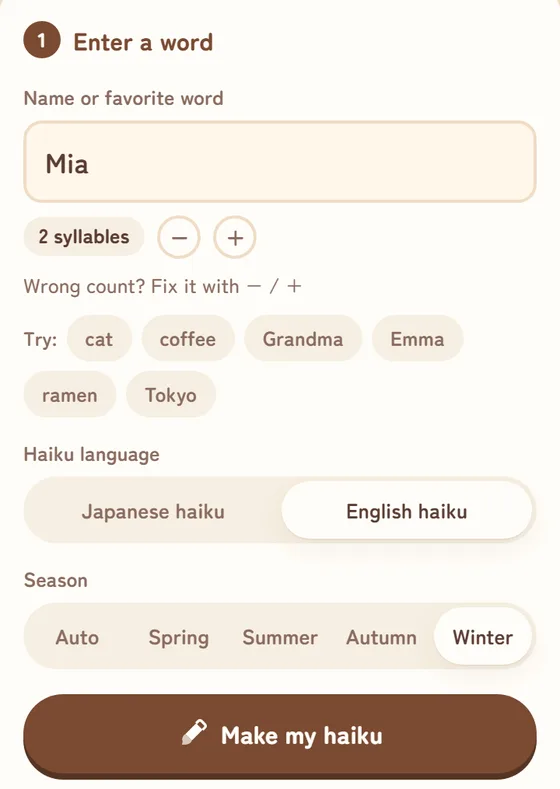
Open the Haiku Maker, type a name or favorite word, choose English or Japanese haiku, pick "Winter" as the season and tap "Make my haiku." Syllables are counted automatically, and you can fix the count with − / + if needed.
2. See the haiku and its season word
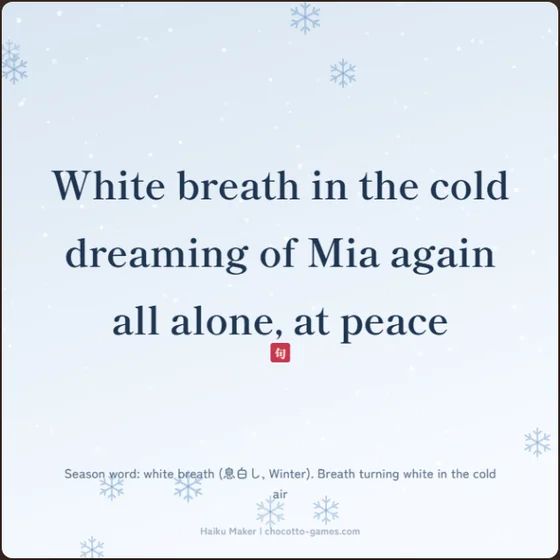
Your haiku appears on a card, with the season word and its meaning underneath. Tap "Make another" as many times as you like.
3. Make it your own
Use the result as a starting point, then swap in details from your own day. If you are writing for a class, follow your teacher's rules. You can also save the haiku as an image card for a message or a winter keepsake. Nothing you type is uploaded; everything is made on your device.
FAQ
Does a haiku need a season word?
Traditional Japanese haiku include one. Haiku without a season word exist too, but adding one is the classic approach and helps the reader picture the scene.
Is the Haiku Maker free?
Yes. No sign-up, no limits. It does not use AI; it combines a season-word dictionary with phrase patterns that fit 5-7-5.
Summary
- Winter in the haiku calendar starts on November 7 in 2026; New Year words are a separate season
- Use one season word and one real moment
- Stuck? Get ideas from the tool, then rewrite in your own words
Write a winter haikuTurn a name or word into a 5-7-5 haiku with a season word.Open the tool
See all our free tools on the tools page, or browse more how-to articles.
Checked by running the tool on November 3, 2026. The date of Rittō is from the National Astronomical Observatory of Japan.
If you find any errors, please let us know via our contact page and we will correct them.